


Page content
What’s your role?
I’m a Science Operations engineer at the European Space Agency’s European Space Astronomy Centre (ESA’s ESAC). I work mainly on ESA's Gaia mission, developing, testing and validating the processing and calibration needed to turn measurements from the spacecraft into accurate scientific data.
I also work on LISA, ESA's future gravitational-wave observatory, helping to develop its science operations and data-processing framework.
How long have you worked at ESAC?
I have worked at ESAC since 2012, so for around 14 years. My role has evolved considerably during that time as Gaia moved from preparation and commissioning through operations and data processing, and then to the end of spacecraft operations. More recently, I have also started working on LISA.
What did you study?
I studied astronomy/astrophysics and went on to do a PhD in the field, rather than studying space engineering. My route into ESA was through the scientific side of space missions: data processing, calibration and understanding the behaviour of the instruments and their data.
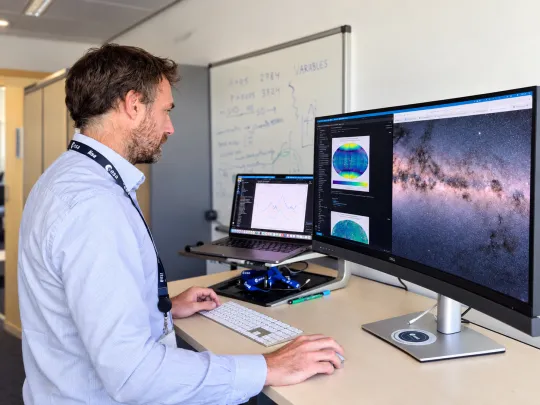
Not having studied space engineering directly wasn't a problem. Space missions need people from many different backgrounds, and over the years I have learnt a great deal about spacecraft, instruments and mission operations by working closely with scientists, engineers and other specialists.
What do you love most about your job?
I like the combination of science, problem-solving and working with people with very different areas of expertise. A problem might involve understanding an astronomical measurement one day and the behaviour of a detector, spacecraft or data-processing system the next.
I also really enjoy the fact that you can work on a mission for many years and see it develop from an idea and a spacecraft into something that produces completely new science.
Tell us about a highlight while working for HE Space at ESAC
One of the highlights for me has been following Gaia through such a large part of its mission.
The commissioning phase was particularly memorable. It was an extremely intense period, with many different groups working closely together: industry, the Mission Operations Centre, the ESA project team, the Gaia Data Processing and Analysis Consortium (DPAC), and scientists and payload experts trying to understand exactly how the spacecraft and instruments were behaving in space.
I then had the opportunity to continue working on Gaia throughout its operational lifetime, right through to the final spacecraft activities and passivation. It is quite special to have been involved from those intense early days all the way to the end of spacecraft operations.
The story is not over: Gaia Data Release 4 is due on 2 December this year, with the final Data Release 5 still to come. The scientific legacy of the mission will continue for many years.
Why is working at ESAC appealing?
ESAC is a very international and multidisciplinary place to work. You are surrounded by scientists, engineers, software developers and operations specialists working on many different ESA science missions, and there are always opportunities to learn from people outside your own area.
Working for HE Space at ESAC also gives you the opportunity to become closely integrated into ESA mission teams and to take on real responsibilities within major space missions. You don't necessarily need to come from a traditional space-engineering background either – missions need people with a wide range of scientific, technical and software skills.
For anyone interested in space, I think it is a particularly rewarding environment because you can see how the work you do contributes directly to a real mission and, ultimately, to its scientific results.